Are You Slowing Down Your Company’s Growth Without Realizing It? The 8 Invisible Barriers Keeping You in Firefighting Mode

Growth is often associated with increased sales, added resources, or new opportunities.
In reality, growth is rarely linear. It is more often experienced like a ball of yarn; complex, tangled, and sometimes difficult to structure, especially when you’re in the middle of it.
What makes it even more confusing is that slowdowns don’t always show up in obvious ways. They don’t take the form of a clear problem or a visible obstacle. Instead, they settle in as a kind of organizational fog: the feeling of moving forward, but without real acceleration.

In this context, the question is no longer simply: “How can we grow more?”
But rather: “Are there internal factors already slowing down your growth without you being fully aware of it?”
The Fundamental Challenge of Growth: Navigating Between Strategy and Operations
As a company evolves, a tension emerges between two complementary realities that are often poorly balanced.
On one hand, operations require constant attention. You need to deliver, respond to clients, manage teams, and deal with the unexpected. On the other hand, strategy requires stepping back, thinking critically, and prioritizing over time.
The challenge is not to choose between the two, but to navigate effectively between these levels.
Yet in many organizations, an imbalance gradually sets in. Operations take over, urgencies dictate the pace, and the company shifts into a reactive mode.
This mode, often referred to as “firefighting mode”, helps keep things running, but it does not allow for structured, sustainable growth.
A Simple Tool to Assess Your Organization
Before identifying the barriers, it’s useful to take a moment to evaluate your current level of clarity and alignment.
Here are five key statements. Take a sheet of paper (or note them mentally) and assign a score from 1 to 5 for each, where:
1 = strongly disagree
5 = strongly agree
Then, add up your five responses to get a total score out of 25.
The statements:
- Your mission and value proposition are clear enough to enable autonomous decision-making
- You have identified the levers that truly drive your economic engine
- Your team meetings translate your objectives into concrete actions
- Your teams work in synergy, without silos
- Your roles, processes, and decision criteria are documented
This total gives you a quick snapshot of your organization.
The interpretation is revealing:
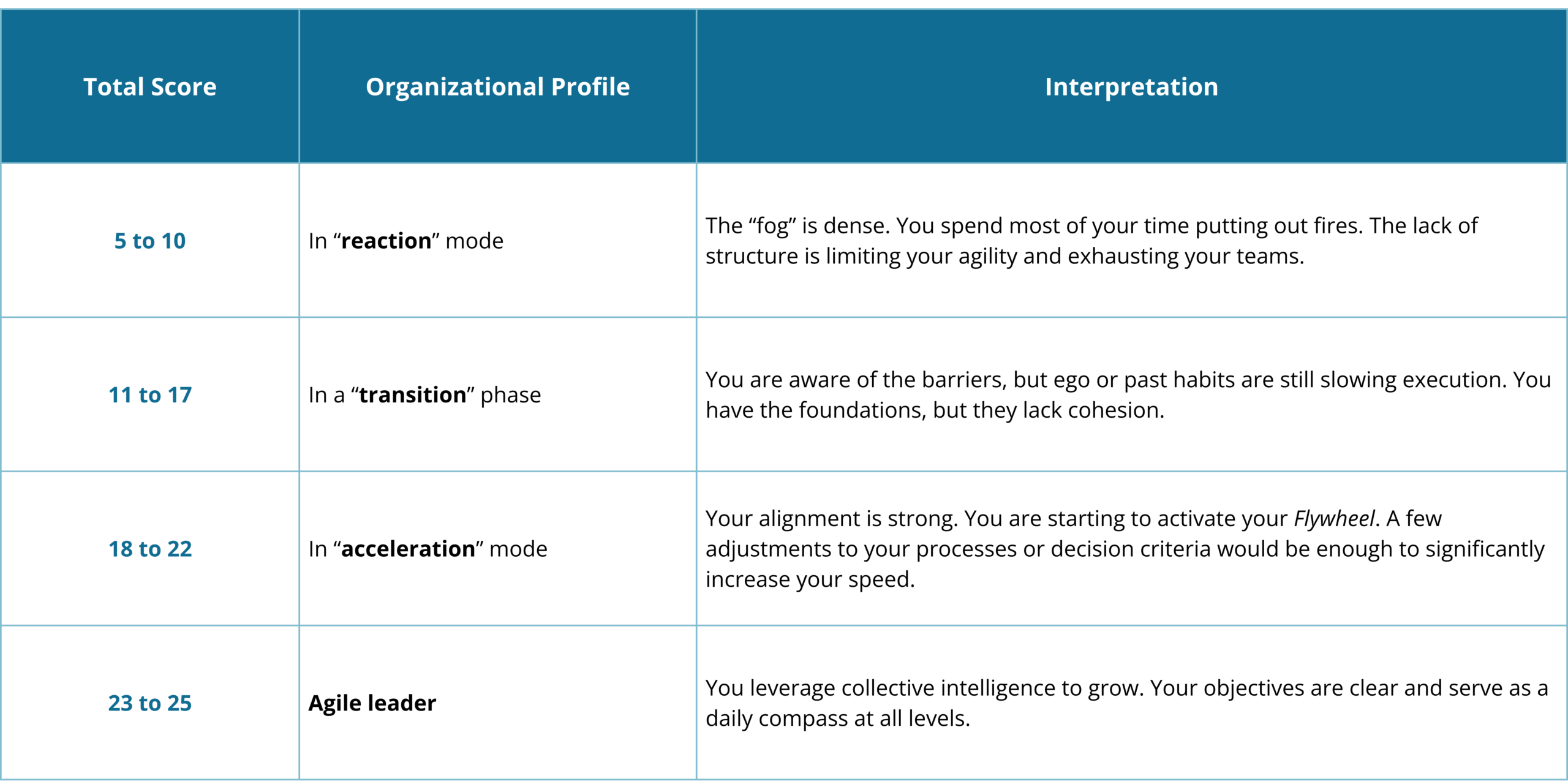
This type of diagnostic highlights a key point: growth is not just a matter of effort, but of structure and organizational coherence.
The 8 Invisible Barriers Slowing Down Growth
These barriers are not always perceived as problems in themselves. They tend to settle in gradually, often as side effects of growth itself.
They can be grouped into two main categories:
- strategic barriers
- operational barriers
Strategic barriers: when direction lacks clarity
1. Absence of a Flywheel (economic engine)
The first barrier is the absence of a clear economic engine (Flywheel), a concept drawn from Good to Great by Jim Collins. Without a precise understanding of growth drivers, efforts become scattered and priorities shift based on urgencies or trends. The Flywheel represents the few key levers that, when activated together, create momentum and cumulative growth. When these levers are not clearly identified, it becomes difficult to know which actions truly drive growth and which merely create activity.
2. Firefighting
When everything becomes urgent, the organization shifts into a reactive mode. Short-term issues take priority, strategic thinking is postponed, and there is no time to build structure. While this way of operating may seem effective in the short term, it prevents the organization from building the conditions needed for sustainable growth.
3. Team misalignment (silos)
When marketing, sales, operations, and customer service are not working toward the same direction, the customer experience becomes fragmented. This lack of alignment does more than slow execution; it creates internal friction and reduces the organization’s ability to adapt quickly.
4. Decision paralysis
When decisions consistently escalate to leadership, a committee, or a single individual, they become a bottleneck. This slows down the organization, limits team autonomy, and prevents opportunities from being seized at the right time.
Operational Barriers: When Execution Lacks Consistency
5. Shiny object syndrome
When faced with a new idea, trend, or tool, it becomes tempting to change direction. The problem isn’t innovation; it’s abandoning what was already working too soon. Growth relies on focus and consistency, not on multiplying initiatives.
6. Avoidance
Some decisions are postponed: ending a misaligned client relationship, addressing an internal issue, or making a call on a strategic direction. These unmade decisions don’t disappear. They accumulate and become persistent barriers that slow the organization down.
7. Ineffective meeting rhythms
When meetings lack a clear objective, are used only for updates, or don’t lead to decisions, they lose their structuring role. Without a clear cadence, teams lose their rhythm and execution becomes disorganized.
8. Lack of clarity in “sandboxes”
When responsibilities, roles, and decision rules are not clearly defined, teams hesitate. This lack of governance creates zones of uncertainty that slow down initiative and execution.
An Often Overlooked Reality: Slowing Down to Accelerate Better
In most cases, the organizations we support lack neither talent nor commitment. Teams work rigorously, leaders are deeply involved, and initiatives are multiplying at every level of the organization.
Despite this, a gradual slowdown sets in, often difficult to explain and even harder to correct.
One recurring observation stands out: growth does not stall due to a lack of effort. It slows down because priorities lack clarity, teams are not fully aligned, and decisions are not grounded in sufficiently structured frameworks to support execution.
In other words, it’s not energy that’s missing, but the coherence of the system in which that energy is invested.
Identifying these barriers is not a weakness. On the contrary, it is an essential step toward regaining control of your trajectory and transforming reactive growth into structured growth.
In many cases, the solution does not lie in adding more effort, tools, or initiatives, but in the ability to operate differently by clarifying direction, structuring decision-making mechanisms, aligning teams around a shared understanding of reality, and establishing a rhythm that sustains execution over time.
By clearing this organizational fog, a company can truly regain its ability to accelerate and create the conditions for sustainable growth.
What’s Next?
Once the barriers are identified, the question naturally becomes more concrete: how can you structure sustainable growth without adding complexity or burdening the organization?
We explore this question in detail in the next article, where we present a five-lever method to move from a reactive mode to an acceleration mode, built on clear, aligned, and actionable foundations. Read the article: From Reaction to Acceleration: Structuring Sustainable Growth in 5 Levers
To go deeper and better understand how to apply these concepts in practice, you can also watch the webinar replay: Access the webinar replay (in French).
Category
Share