How to build an effective marketing budget, in 5 steps

As entrepreneurs, we all understand the importance of creating and managing a marketing budget. But how do we know if we are investing our efforts (and our dollars) in the right places? How do we build a marketing budget based on our ideal customer and eliminate “random” spending?
A marketing budget is neither a list of expenses nor a standalone exercise. It reflects an organization’s business priorities and its understanding of the market. When poorly structured, it becomes rigid or reactive. When well built, it supports growth and simplifies decision-making.
One point must be clarified from the outset. The marketing budget is an annual exercise, aligned with sales projections. The marketing action plan, on the other hand, must be broken down by cycles and by quarters. Budgets should not be iterative; actions should be.
Step 1 – Start with business objectives
An effective marketing budget always begins with business objectives. Marketing does not set its own targets independently. It aligns with desired growth, targeted stability, or the organization’s strategic priorities. In most cases, the marketing budget is realistically defined following a sales forecasting exercise.
At this stage, some organizations define their marketing budget as a percentage of projected sales, while others integrate it directly into the cost of goods sold (COGS). The choice depends on the business model, margins, and maturity level. What truly matters is not the formula, but alignment with financial reality.
When marketing is tied to sales or to COGS, it stops being a discretionary expense that needs constant justification. It becomes a planned and structured lever.
When integrated into COGS, marketing becomes a cost per sale, funded continuously, which is particularly relevant when each transaction requires a direct marketing effort. Managed as a percentage of sales, it evolves with growth and enables more stable and strategic planning.
These approaches deserve deeper exploration. Another blog post will cover this concept in more detail. Sign up to our newsletter!
Step 2 – Segment the market to make clear choices
Speaking to “everyone” means diluting your budget.
A marketing budget cannot cover everything. Market segmentation helps identify where to focus efforts. Some segments are more strategic than others, depending on the year, objectives, and growth potential. This step prevents budget dispersion and forces clear choices.
Step 3 – Understand the persona and their buying journey
Once segments are defined, it is essential to understand how customers actually buy. Where do they look for information? At what moment? With what level of urgency? How many stakeholders are involved in the decision?
This understanding prevents building a budget around popular channels rather than real behaviours. The budget should support the buying journey, not try to force it.
Step 4 – Define selection criteria to build the right marketing mix
Not all purchases require the same level of marketing effort.
Depending on:
- the impact of the purchase
- the complexity of the product or service
- the price
- the length of the decision-making process
- the urgency of the need
- the optimal marketing mix will vary
This is where the balance is determined between:
“push” channels (going to the customer)
“pull” channels (bringing the customer to you)
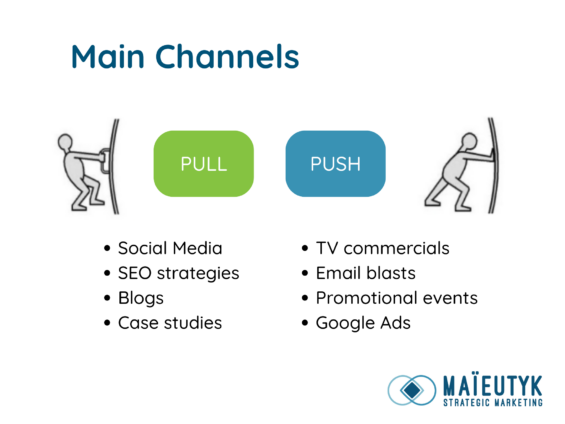
At this stage, the budget begins to take shape based on customer choices rather than the tactics available.
Step 5 – Allocate the budget by strategic priorities
An effective marketing budget does not start with expense lines.
❌ “Google Ads: $800 / month”
❌ “Video production: $5,000”
It starts with quarterly strategic priorities, your true “rocks”:
- Acquisition
- Customer experience
- Journey improvement
- Product or service line growth
- Repositioning
Once these priorities are clear, the budget can be allocated:
- by channel
- by campaign
- by test
- by cycle (quarter)
This logic is exactly what makes it possible to build a living action plan, adjusted every 90 days, without questioning the annual budget envelope.
A budget in service of execution
A well-structured marketing budget simplifies decision-making. It allows actions to be adjusted without revisiting the overall envelope. It supports marketing discipline and avoids improvisation.
When built in the right order, the budget ceases to be a financial constraint. It becomes a strategic tool that supports growth and long-term alignment.
Category
Share