Marketing Budget: 5 Mistakes You Must Avoid

Building a marketing budget should be both a logical and strategic exercise. Yet in many organizations, it remains one of the most improvised processes. Marketing is often perceived as a series of expenses and tactics rather than a structured growth lever, which leads to budgets that are disconnected from the market, the customer, and business objectives.
Here are the most common mistakes we observe and why they hinder performance.
Mistake 1: Not having a budget at all… and moving on impulse
This is the most widespread mistake. Many businesses do not have a formal marketing budget. They act reactively when an idea comes up, a colleague suggests a tactic, or an opportunity appears on a channel like Google Ads, and they decide to “try it.” These decisions create the impression that marketing is happening, but they do not fit into any coherent vision. Without a clear financial framework, it becomes impossible to evaluate real performance, understand priorities, or invest where it truly matters.
A marketing budget is never a simple list of spontaneous initiatives. It is the result of a structured reasoning process that begins with market segmentation and understanding your persona: where they are, how they consume information, what they are looking for, and what influences their decisions. Only with this understanding does spending begin to make sense.
Mistake 2: Building the budget around channels instead of customers
This mistake often comes from the first one. Many organizations start their budget by deciding how much to invest in a specific channel: “We will put $1,000 a month into ads,” “We should increase our LinkedIn presence,” “We will create more videos this year.” But channels are never a strategy. They are only vehicles.
A substantial budget is built in the opposite direction. It starts by defining priority segments, understanding decision criteria, mapping the buying journey, and identifying the moments when your persona searches, hesitates, compares, and decides. Only once this map is clear can you determine which channels are actually relevant. The budget then becomes an innovative allocation tool rather than a gamble on popular platforms.
Starting with channels means letting the tool decide the strategy. Starting with the customer means using the budget as a lever to meet real needs.
Mistake 3: Neglecting operations, the equivalent of driving a car with no maintenance
Another common mistake is allocating most of the budget to acquisition campaigns, advertising, and events while overlooking maintenance of the marketing engine itself. SEO, website optimization, updated content, page consistency, loading speed, and user experience are not always visible, but they directly influence the performance of your investments.
Investing in ads without optimizing your site is like buying a new car and believing it will perform flawlessly for years without any maintenance. It may run for a while, but without regular upkeep such as oil changes, alignment, or inspections, its performance inevitably declines.
Marketing operations work the same way. It is not a one-time investment made at the launch of the website; it is continuous maintenance that supports performance year after year. An adequate budget always includes a portion dedicated to ongoing improvement and organic performance.
Mistake 4: Underestimating retention; the most profitable but most overlooked lever
Retention is one of the most neglected pillars of marketing budgets. Many companies assume their customers will return automatically. In reality, customers rarely leave out of disloyalty; they leave because they have not been cared for.
The telecommunications industry illustrates this perfectly. They offer aggressive promotions to attract new customers while ignoring current ones until they eventually leave. This dynamic exists across every industry: a stronger focus on acquisition, and not enough on retention. Yet retention often unlocks underused internal revenue sources such as cross-selling, upselling, loyalty programs, and improvements to the customer journey. The marketing budget should never be reserved exclusively for “bringing in new customers.” It must also support the maintenance of existing relationships, where profitability is the highest.
Mistake 5: Confusing the annual budget with the action plan and lacking discipline
The marketing budget is an annual exercise aligned with sales projections and business objectives. It sets the overall investment capacity. The marketing action plan, however, is a living document structured around cycles and quarters, with clear priorities. It is not the budget that should be iterative; it is the campaigns. The budget defines the framework; execution optimizes the return. But this distinction only holds if the organization adopts real marketing discipline. Marketing often falls into the “important but not urgent” category, making it easy to push aside. Yet businesses that reduce their marketing efforts lose momentum, consistency, and relevance, leaving the door open for competitors.
History and data are clear. Organizations that maintain or strengthen their marketing during challenging periods outperform their competitors during recovery. Marketing is never urgent… until it becomes too late to regain lost ground.
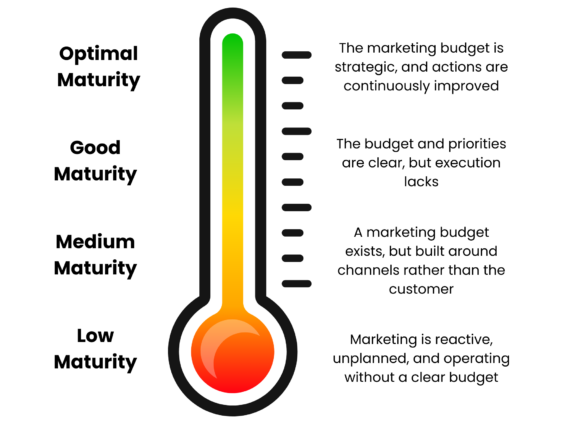
MARKETING BUDGET MATURITY THERMOMETER –
WHERE DO YOU STAND?
Conclusion: A budget is not a cost; it is a reflection of your understanding of the market
When a budget comes from instinct or tools, it becomes a tactical patchwork. When it comes from strategy, it becomes a growth engine. Successful organizations do not ask, “How much should we spend?” but rather, “What does our customer require, and how does our budget reflect that reality?” This perspective is what transforms a marketing budget into a sustainable competitive advantage.
Category
Share