When AI Becomes the Intermediate: How New Digital Visibility Rules Will Affect Your Business

Key Points
- Digital visibility has changed: an increasing proportion of searches end without a click, reducing direct traffic to your site.
- LLMs no longer simply direct users to sources; they analyze, synthesize, and curate visible information.
- SEO remains essential, but it is no longer sufficient on its own: you must also produce content that is understandable, credible, and structured for AI.
- For SMBs, this transformation also represents a strategic opportunity: the most agile organizations can adapt their content, positioning, and digital presence more quickly.
The digital landscape we once knew, long-centered on a list of blue links, is gradually giving way to a more conversational, synthetic, and predictive interface.
Today, artificial intelligence (AI) is no longer merely a tool for information retrieval; it has become a key intermediary between your business and your potential customers. Whether it’s Google’s AI Overviews, ChatGPT, Gemini, Copilot, or other response engines, the rules of digital visibility are changing rapidly. This transformation is all the more significant given that 47% of Google search results now incorporate AI, while up to 60% of searches end without a click, as users get their answers without ever visiting the source site.
The question is no longer simply how to rank well on Google. It’s become more complex: how do you ensure that artificial intelligence understands your content, recognizes your expertise, and chooses to cite you?
A Paradigm Shift in the Customer Journey
The customer journey no longer follows the same logic as before, and no longer systematically involves a visit to your website, as it once did. For a long time, search engines served as a relatively neutral intermediary between your business and your audience. The user would enter a query, Google would display a list of results, and then the visitor would choose which sites to visit. In this model, SEO was primarily aimed at improving the ranking of your content to make your site more visible on the results page.
In other words, when your SEO (Search Engine Optimization) strategy was executed well, Google facilitated access to your content but did not replace it. Your site remained the place where the answer unfolded, where the pitch took shape, and where the relationship with the visitor could truly begin.
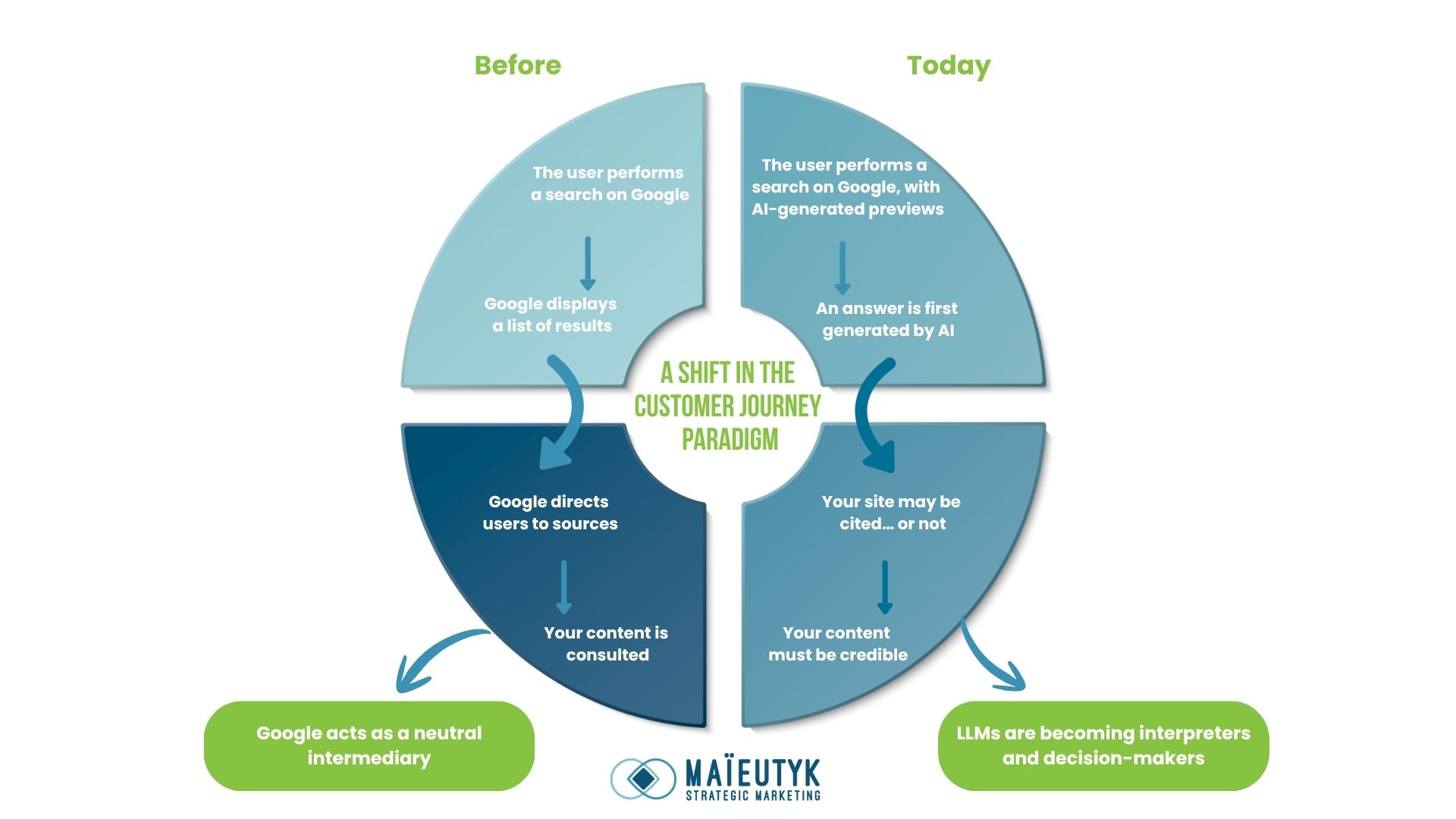
Today, this paradigm is undergoing a profound shift. Language models such as ChatGPT, Gemini, Claude, and Perplexity no longer function merely as gateways to information. They analyze it, synthesize it, rephrase it, and decide what to present to the user. In this sense, they no longer merely act as intermediaries: they have become both interpreters and decision-makers regarding the information that is visible.
This is where the shift becomes strategic for organizations. In the past, the main challenge was to rank highly in search results to attract clicks to one’s website. Today, it is no longer enough to be well-positioned; one must also be understood, deemed relevant, and selected by AI systems that construct the response themselves. The role of SEO is not disappearing, but it now operates within a more demanding reality, where ranking alone no longer guarantees access to attention.
Your content is no longer simply viewed. It is absorbed, cited, or ignored; a clear illustration of the current shift. Whereas Google was primarily used to direct users to sources, Large Language Models (LLMs) now directly influence how information is interpreted, prioritized, and conveyed.
For businesses, the challenge is no longer simply to appear in search results but to become a source that is clear, credible, and well-organized enough to be included in the responses generated by artificial intelligence.
Why this shift particularly affects small and medium-sized businesses
At first glance, this transformation may seem disadvantageous for small and medium-sized businesses (SMBs), especially when compared to the resources large organizations have at their disposal to establish a digital presence. However, this new landscape also presents a genuine strategic opportunity for smaller businesses.
Their main advantage lies in their ability to adapt. Where large organizations often move more slowly, SMEs can adjust their content, digital presence, and communication strategies more quickly. In an environment where the rules of visibility are changing rapidly, this agility becomes a significant competitive advantage.
This reality is all the more significant given that artificial intelligence tools favour clear, structured, and credible sources. For an SMB, the risk is not only having fewer resources but also being insufficiently visible in an ecosystem where algorithmic synthesis selects, prioritizes, and rephrases information. Without structured content, signals of expertise, or a consistent digital presence, a company can quickly lose visibility, even when it offers a relevant product or service.
That is why this shift should not be viewed merely as a technical constraint. Rather, it calls for a broader reflection on how to structure growth, clarify market positioning, and align one’s digital presence with new search behaviours. Companies that begin this work now will be better equipped to strengthen their visibility and relevance in their market. Conversely, those who delay adapting risk seeing their presence gradually erode.
This perspective aligns with a conviction already deeply rooted in Maïeutyk’s content: sustainable growth does not rely on an accumulation of tactics, but on a coherent, structured, and aligned system. To explore this perspective further, you can also read our article «From Reaction to Acceleration: Structuring Sustainable Growth in 5 Levers ». which explores how to turn external pressures into opportunities for restructuring and acceleration.
SEO remains at the heart of your visibility, even in the age of LLMs
As artificial intelligence transforms the mechanisms of digital visibility, it may be tempting to believe that organic search is now a thing of the past. In reality, the opposite is true. SEO isn’t going away; it remains the foundation upon which other visibility levers rest.
Technical aspects, content, and authority continue to play a central role. Without a solid structure, it becomes much more difficult for search engines, as well as AI tools, to understand your offering, interpret your content, and recognize its value. A slow, poorly organized, or difficult-to-navigate website still limits your ability to be found, understood, and recommended.
This shift, however, calls for a broader approach to search engine optimization. It is no longer just about ranking for keywords, but about making one’s expertise clear, structured, and understandable in an environment where machines are increasingly interpreting entities, relationships, and contexts. In other words, before seeking to optimize your presence for artificial intelligence, it is essential to ensure that the foundations of your digital ecosystem are sufficiently clear and robust.
In practical terms, this means paying close attention to a few fundamental elements:
- the site’s technical performance and ease of navigation;
- the clarity and relevance of its content;
- the semantic consistency across pages;
- and its ability to demonstrate credible authority on its core topics.
This perspective also aligns with our ongoing reflection on the evolution of search engine optimization in the conversational era. To explore these transformations further and better understand the complementary roles of SEO, AEO, GEO, and AIO, you can read our article «From SEO to AIO: When Optimization Becomes Conversational».
From Visibility to Credibility
In the age of conversation, simply being visible is no longer enough. You must be understandable, relevant, and credible. AI systems look for content that is:
- clear;
- well-structured;
- contextualized;
- written in natural language;
- backed by proven expertise.
This reality builds on several points already discussed in the Maïeutyk blog. Message clarity, precise positioning, and a deep understanding of the market remain essential to the effectiveness of a marketing strategy, particularly in a B2B context. To explore this topic further, you can also read our article « 10 Common B2B Marketing Mistakes to Avoid».
How this changes the way you create content
This shift is fundamentally transforming the way content is designed. It is no longer just about writing to capture a human reader’s attention or to meet traditional SEO criteria. Content must now also be understood, interpreted, and utilized by artificial intelligence systems capable of rephrasing information, prioritizing it, and reusing it in their responses.
In this context, companies can no longer simply publish generic or self-centered content. To remain relevant, they must produce content that answers real questions, sheds light on concrete issues, structures information clearly, and provides real value, beyond mere online presence.
This reality, therefore, imposes higher editorial standards. Content must be:
- useful to the reader;
- easy to interpret by search engines;
- clearly structured so it can be understood, extracted, and reused by AI systems.
These three dimensions are not mutually exclusive; on the contrary, they become complementary in building sustainable visibility.
This also means rethinking certain production habits. Publishing simply to maintain a pace or increase volume is no longer enough. AI tools are already capable of effectively synthesizing generic information. The value of content now depends more on what makes it distinctive, concrete, and credible.
It is often in this more unique material that an organization’s true competitive advantage lies, particularly through:
- on-the-ground experience, which allows for the sharing of lessons learned, successes, or limitations observed in real-world contexts;
- a well-defined perspective, which adds depth to the analysis and enables the company to occupy a clear position in its field;
- data specific to the organization, whether findings, results, analyses, or observations drawn from practice.
In other words, content should no longer be merely published; it must be conceived as a reference resource. The clearer, more structured, more useful, and more grounded in real expertise it is, the more likely it is to inform responses generated by artificial intelligence while retaining what makes it valuable to a human reader: nuance, experience, and perspective.
Take Action
Before creating more content, it’s a good idea to download the file titled “Worksheet for Developing Your Action Plan” which helps you answer relevant questions to better assess your situation.
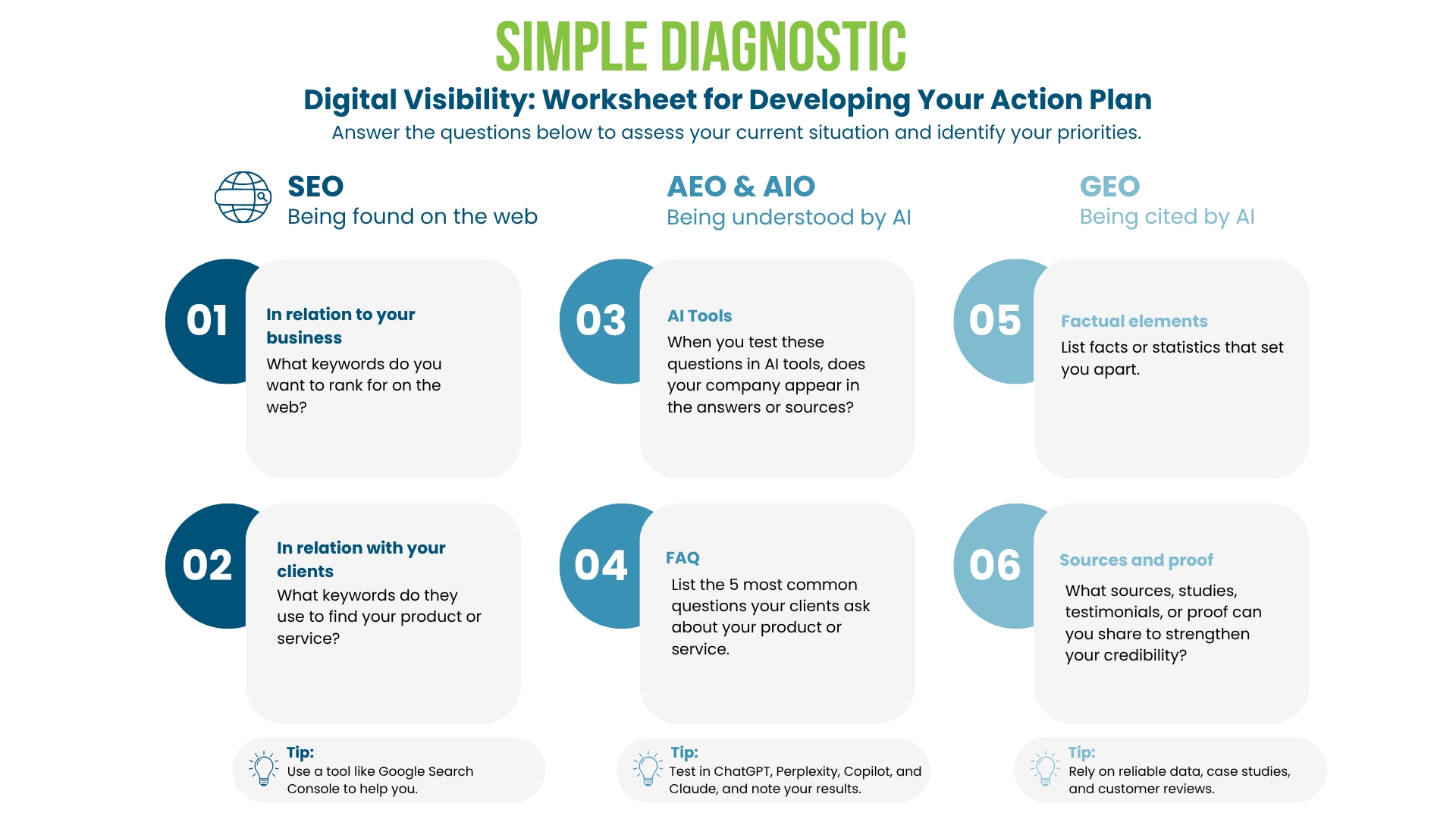
It is often these observations that lead to the most effective projects: clarifying your positioning, optimizing your website, creating expert content, or improving your editorial structure.
To explore these concepts further and see how to apply them in practice, you can watch the webinar recording here: access the recording.
To turn your ideas into action, we invite you to read our next blog post, which focuses on concrete steps you can take to boost your digital visibility: Becoming a Credible Source for AI: 5 Concrete Steps to Boost Your Digital Visibility
Share