From Reaction to Acceleration: Structuring Sustainable Growth in 5 Levers

In the first article, we highlighted the 8 invisible barriers that slow down organizational growth.
This realization is often confronting: despite the effort, initiatives, and team commitment, progress remains limited.
The question then becomes unavoidable: how can this energy be transformed into real, sustainable growth?
Why quick fixes aren’t enough
When facing a slowdown, the instinct is often to add something:
- a new tool
- a new campaign
- a new resource
These initiatives are not necessarily bad. They become problematic when they are layered onto an already misaligned system.
In this context, each new action increases complexity rather than performance.
Sustainable growth is not built on the accumulation of solutions, but on structuring a coherent system that can turn effort into results.
Artificial Intelligence and Collective Intelligence: Finding the Right Balance
The rise of artificial intelligence reinforces this reality. Organizations now have access to powerful tools to automate, analyze, and accelerate certain tasks.
However, these tools do not replace the ability to make aligned decisions and mobilize teams around a shared direction. Artificial intelligence optimizes execution. Collective intelligence, on the other hand, gives it structure and meaning.
Without human alignment, tools amplify disorder. With a clear framework, they become powerful levers for acceleration.
Cocreation as a Strategic Lever
In this context, how decisions are made becomes critical.
Cocreation involves engaging different stakeholders within the organization in strategic thinking, in order to build a shared vision and priorities, rather than imposed ones.
A strategy developed in silos, even if sound on paper, often struggles to translate into execution. In contrast, a co-creation approach helps align perspectives, clarify priorities, and foster team buy-in.
Cocreation is not about seeking consensus at all costs. Rather, it aims to build a shared understanding of reality so that decisions are clear, relevant, and implemented quickly.
It is this alignment capability that turns strategy into a true lever for growth.
The 5 Levers to Structure Sustainable Growth
Rather than adding layers of complexity, the goal is to structure the organization’s fundamentals around five complementary levers, consistently observed in companies that successfully accelerate their growth.
1. The flywheel: clarifying the economic engine
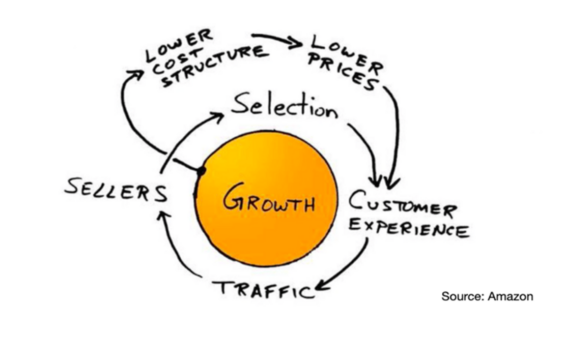
The flywheel, a concept from Good to Great by Jim Collins, represents the key levers that drive growth and, when activated together, create momentum.
It shifts the organization from a set of scattered initiatives to a systemic approach, where each action strengthens the overall engine.
Without this framework, efforts may accumulate, but they don’t necessarily multiply.
Example:
2. The strategic plan: providing a clear direction
The strategic plan defines a starting point, clear objectives, and the steps needed to achieve them.
It is not just a planning exercise, but a structuring framework that guides decision-making and helps prioritize daily actions. Key performance indicators (KPIs) play a central role, acting as a compass to stay on course.
Without this direction, individual efforts may be relevant, but lack coherence at the organizational level.
3. 90-day cycles: establishing an execution rhythm
Quarterly cycles help translate strategy into concrete actions while maintaining a high level of focus on priorities.
They create momentum within teams and allow for quick adjustments based on results, making the strategy truly executable rather than theoretical.
This rhythm acts as a bridge between long-term vision and day-to-day execution.
4. Segmentation and personas: focusing efforts
Sustainable growth relies on the ability to make clear choices about the target market and the ideal customer.
Trying to address everyone often leads to diluted impact. In contrast, clearly understanding the needs, challenges, and expectations of a specific segment helps align marketing, sales, and service around a shared reality.
This focus strengthens relevance and improves conversion.
5. Customer journey mapping: aligning the experience
Customer journey mapping helps understand the different stages a customer goes through, the friction points, and the interactions between teams.
It acts as a cross-functional alignment tool, connecting internal functions around a consistent and seamless experience.
By identifying friction and breakdown points, it not only improves the customer experience but also accelerates delivery and enhances overall performance.
Structuring to Accelerate: A Systemic Approach
These five levers should not be approached in isolation. They form a coherent system where each element plays a specific role and reinforces the others.
The flywheel defines the engine, the strategic plan sets the direction, the cycles create the rhythm, segmentation brings focus, and the customer journey ensures alignment. It is their coherence that transforms effort into real growth.
Moving from a reactive mode to an acceleration mode does not rely on a radical transformation, but on a progressive and coherent structuring of the organization. It’s not about doing more, but about better aligning what already exists—by clarifying priorities, simplifying decisions, and connecting actions together.
It is this ability to structure the system as a whole that restores speed and supports sustainable growth.
Taking action
If you’ve identified some of these barriers within your organization, the next step is to structure these levers in a concrete way, tailored to your reality.
To go deeper and better understand how to apply these concepts, you can also watch the webinar replay: Access the webinar replay in French.
If you’d like to go further and structure your next phase of growth, we invite you to book a meeting for a personalized diagnostic.
Category
Share