Becoming a Credible Source for AI: 5 Concrete Steps to Boost Your Digital Visibility

Key Points
- Search engines are increasingly taking the place of content sources.
- SEO remains important, but it must now work in tandem with AEO, AIO, and GEO.
- Visibility no longer depends solely on clicks, but also on the ability to be understood, deemed relevant, and cited.
- Clear, structured, credible, and useful content is becoming a strategic asset.
Realizing that the rules of the game are changing is the first step. But for an organization, the real question remains: what concrete steps can be taken to stay visible in an environment where search engines no longer simply index information, but synthesize, prioritize, and rephrase it?
The search journey has changed. Search engines no longer simply display results: they increasingly interpret, synthesize, and respond on behalf of the sources. As a result, companies are losing some of the control they once had over their visibility. Their content is no longer just viewed; it must now be understood, deemed relevant, and adopted by artificial intelligence systems.
To better grasp this transformation and review the basics before going further, we invite you to read our article « When AI Becomes the Intermediate: How New Digital Visibility Rules Will Affect Your Business».
There, you’ll find the context needed to understand why the customer journey, search mechanisms, and the logic of visibility are evolving so rapidly.
The next logical step is to move from awareness to action.
While artificial intelligence is indeed transforming discovery mechanisms, it does not eliminate the foundations of a strong digital presence. Rather, it requires a more structured, consistent, and editorially rigorous approach. In other words, organizations that want to be featured, recommended, or cited by AI tools must clearly articulate their expertise, bring greater clarity to their content, and strengthen the trust signals they send across their digital ecosystem.
A few guidelines before taking action
Before moving on to concrete actions, it is helpful to identify the key drivers that shape digital visibility today.
SEO (Search Engine Optimization) refers to the practice of optimizing for traditional search engines. Its purpose is to make your website discoverable in the organic search results of Google and other search engines. In other words, it involves improving your ranking so that your content is visible to the right people at the right time. In this context, SEO remains a matter of discoverability. It’s what allows you to secure a good spot in the digital ecosystem, in a way, a kind of rental model.
AEO (Answer Engine Optimization) takes things a step further. It’s no longer just about being visible in a list of results, but about becoming the answer to a specific question. This requires producing clear, direct, and structured content that can be incorporated into answer engines, rich snippets, or conversational environments. Here, the goal is to be immediately useful. It’s a service-oriented approach.
AIO (Artificial Intelligence Optimization) concerns how an organization makes its expertise understandable to artificial intelligence. The goal is to demonstrate who you are, what field you operate in, and why your content deserves to be featured. This is achieved through authored content, case studies, biographies, testimonials, and structured data. AIO is therefore based on a logic of expertise.
GEO (Generative Engine Optimization), on the other hand, aims to increase the likelihood that your content will be referenced, mentioned, or cited in the responses generated by language models. It relies on factual, well-structured, contextualized content that is credible enough to be deemed trustworthy. Here, the goal is no longer simply to be found or understood, but to be cited. It is a matter of establishing authority.
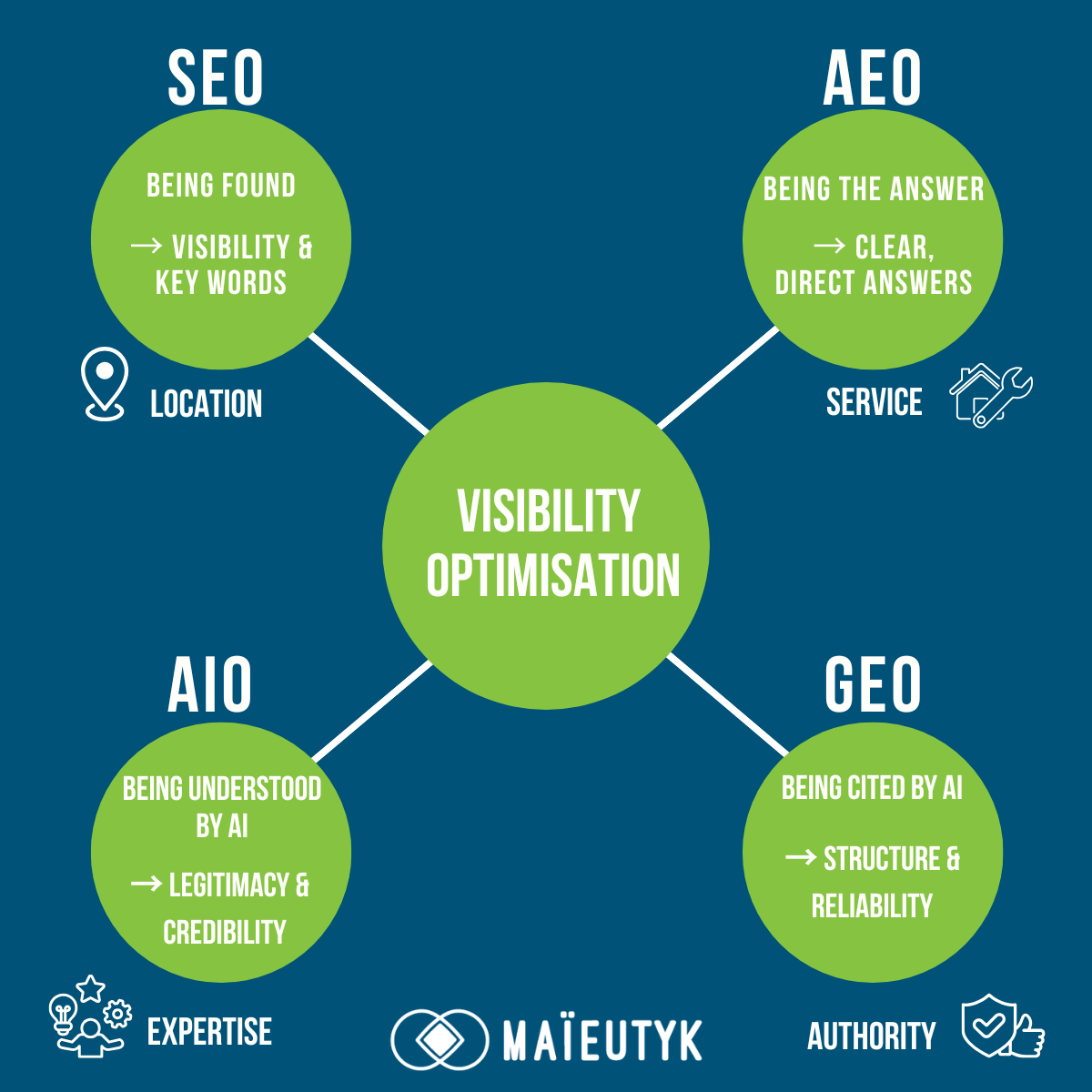
These strategies are not mutually exclusive; they complement one another. SEO remains essential, but it now operates in an environment where visibility also depends on the quality of responses, the clarity of expertise, and the ability to become a credible source for artificial intelligence systems.
Here are five priority actions to get started:
1.Being discoverable: strengthening your SEO foundation
Your first instinct shouldn’t be to publish more content, but to ensure that your foundation is truly solid.
Search engine optimization remains the foundation upon which all sustainable visibility is built. The site’s technical performance, the quality of its site architecture, loading speed, consistent markup, content structure, and subject authority continue to play a central role. Without this foundation, it becomes much more difficult for search engines and artificial intelligence tools to understand your offering, interpret your content, and recognize its value.
This development is part of our ongoing exploration of how search engine optimization is evolving. To learn more about this topic, you can also read « From SEO to AIO: When Optimization Becomes Conversational », where we explore the complementary roles of SEO, AEO, GEO, and AIO in new search environments.
Before attempting to optimize your visibility for AI, you must therefore ensure that your site is:
- technically accessible;
- easy to crawl;
- semantically consistent;
- credible on the topics it claims to cover.
In other words, optimization for AI does not replace SEO. It builds upon it.
2.Identify your customers’ real questions
The second task involves moving away from internal jargon and returning to the customer’s actual language.
Too many organizations still produce content based on their own vocabulary, internal structure, or product logic. However, in today’s search environments, it is concrete phrasing, specific questions, and users’ actual intentions that drive content discovery.
This requires more rigorous listening. What questions come up most often in meetings? What words do your clients actually use to describe their challenges? What terms do they use on Google, in ChatGPT, or in their conversations with colleagues before even contacting you?
This step is particularly important in B2B. An effective strategy rarely starts with the channel; it starts with a deep understanding of the market, the persona, and the context in which needs arise. On this point, our article « 10 Common B2B Marketing Mistakes to Avoid», provides additional useful guidelines for avoiding overly broad topics or messages that aren’t sufficiently targeted.
The more your organization aligns with the actual language its customers use, the greater its chances of producing content that is relevant, discoverable, and reusable.
3.Be the answer: create useful and clear content (AEO)
In a conversational environment, effective content isn’t just content that exists; it’s content that clearly addresses a specific intent.
This means producing useful, straightforward, and well-structured content that genuinely helps readers understand a concept, compare options, clarify a decision, or answer a question.
The most effective formats are often the simplest:
- well-crafted FAQs;
- focused Q&A pages;
- clear definitions;
- articles focused on a specific intent;
- educational content that makes the subject easier to understand.
This logic is at the heart of AEO, or answer engine optimization. The goal is no longer just to generate traffic, but to become the most relevant resource when a question is asked in an environment where the answer may precede the click.
Good content should therefore not be designed to “fill a blog” or to maintain a posting schedule. Rather, it must contribute to building an intelligible knowledge base that can be read by a human, interpreted by a search engine, and utilized by an artificial intelligence tool.
4.Be recognized as an expert: demonstrate your credibility (AIO)
Training AI isn’t just about publishing content. It’s also about demonstrating why your organization deserves recognition as a reliable source.
In a world where language models evaluate, synthesize, and select content, credibility becomes a strategic signal. Your website must clearly answer four questions:
- who is speaking;
- with what legitimacy;
- in what field;
- with what consistency.
This requires authored content, expert biographies, case studies, testimonials, more detailed service pages, coherent internal links, and evidence-based signals that build trust. It is no longer enough to simply claim expertise; it must be made visible, readable, and contextualized.
This requirement for credibility aligns with several principles already present in Maïeutyk’s content. Consistency between positioning, message, offering, and concrete evidence remains essential for building lasting visibility. On this topic, you can also read « How to Build an Effective Referral Program Aligned with Your Brand » as well as « From Reaction to Acceleration: Structuring Sustainable Growth in 5 Levers».
In AI-driven environments, brand recognition alone is not enough. What matters is the ability to become a credible authority on a given topic.
5.Being referenced by AI: Structuring Content for Citation (GEO)
Beyond the content itself, form also matters. Content most likely to be picked up in generative environments is often that which is easy to read, interpret, and extract information from. This means that good content must not only be relevant but also structured so that its elements are easy to find.
In practice, this means prioritizing:
- clear subheadings;
- paragraphs focused on one idea at a time;
- lists and step-by-step guides when appropriate;
- comparative tables or summaries when they add real value;
- precise and factual wording;
- clear definitions;
- examples that provide context for the information.
This editorial discipline is particularly useful in a GEO framework. When an article, service page, or product page clearly specifies what an offering is for, who it was designed for, in what context it applies, and what problems it helps solve, it becomes easier to interpret and reuse.
This doesn’t mean you should completely erase your brand’s personality. But certain sections of the site benefit from adopting a more neutral, informative, and structured tone, especially when they serve as a knowledge base or entry point for organic discovery.
Structure Rather Than Publish More
Perhaps one of the most important changes to implement is this: it’s not about redoing everything at once, nor about churning out more content in the hope of taking up more space.
Rather, it’s about working by priorities, based on a clear picture of your digital ecosystem.
- Which pages deserve to be strengthened?
- Which content would benefit from being clarified?
- Which areas of expertise are still not visible enough?
- Where does the current structure hinder understanding of your offering?
This approach of continuous improvement is far more effective than simply piling up isolated tactics. It also aligns with a key concept we’ve already explored in our content on « From Reaction to Acceleration: Structuring Sustainable Growth in 5 Levers»: An organization has a greater impact when it connects its actions rather than simply adding them together without coherence.
Take Action
To kickstart this transition, you don’t need to overhaul everything at once. A simple starting point is to:
- list the 10 questions your customers ask most often;
- check whether your site answers them clearly;
- test these questions on Google and in tools like ChatGPT;
- identify which pages would benefit from being clarified, expanded, or restructured;
- then prioritize two or three high-value pieces of content, rather than producing a multitude of scattered posts.
And if you’d like to identify the topics with the greatest potential for your own digital ecosystem, you can also complete our diagnostic to help clarify your priorities and identify the most relevant opportunities for your organization.
Share