Brand Experience & Content Distribution: The Essential Link in the Age of LLMs

Key Points
- Visibility has declined: even with a high BX, brands have lost between 35% and 61% of their organic traffic since the advent of AI-powered snippets.
- ROI has changed: impressions and clicks are no longer enough. The “zero-click gap” is widening; you need to measure your marketing efforts differently.
- GEO replaces traditional SEO: optimizing to be cited by an LLM requires not only good SEO but also unique data, clear-cut positions, and citation authority built on reference sources.
- The new 4C distribution architecture rests on four foundations: channels, 1:10 content, community, and cycles.
- An authentic human is the only inimitable asset: AI can generate content, but not a genuinely lived-in opinion or a reputation built over years. Original data, embodied thought leadership, and direct conversations matter more than ever.
You’ve built a strong brand. Your customer experience is consistent, your positioning is clear, and your customers love you. And yet… you’re invisible.
This situation isn’t unusual: it’s the new reality of the market. AI has disrupted the rules of the game in content distribution, and strategies that once worked are now getting less effective.
Brand Experience (BX) / Definition
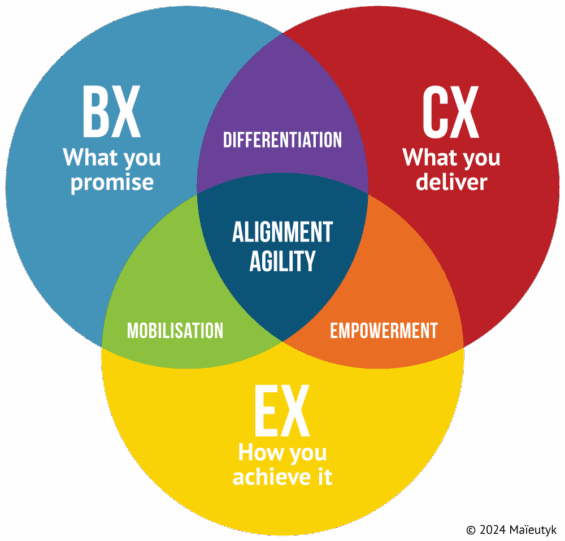
Brand experience, or BX, encompasses all the emotions and perceptions felt by an individual or group regarding your brand. It’s the lasting impression your company creates on the public; it’s the promise your company makes about your product or service. At Maïeutyk, brand experience (BX) is part of a larger whole. When it’s well-integrated with customer experience (CX) and employee experience (EX), alignment is achieved within your company.
Generative Engine Optimization (GEO) / Definition
GEO is the practice of optimizing content to be cited and referenced by major language models (LLMs) rather than simply indexed by a search engine. Unlike traditional SEO, which optimizes for indexing robots, GEO structures information so that it is easily extracted, memorable, and correctly attributed by generative AI.
GEO requires not only well-structured content but also authentic, unique content drawn from personal experience. This is, among other things, what makes this content memorable.
1- The Diagnostic
Why a Strong BX Is No Longer Enough
For years, the model was simple and remains valid: build a brand around its differentiating elements, produce quality content, and optimize for search engines. Visibility naturally follows. But with the rise of GEO, we are facing a different reality.
This model was based on the following principle: the intermediary between your brand and your audience was neutral.
Before LLMs, search engines distributed your content in a relatively predictable way. The algorithm could be analyzed, strategies developed and optimized. SEO was a common language between the brand and the platform.
Today, it’s no longer Google that presents you to your audience. It’s a language model that decides, in its response, whether you exist or not.
LLMs (ChatGPT, Gemini, Claude, Perplexity, etc.) have introduced a radically different intermediary: an AI that synthesizes, summarizes, and responds instead of the information source.
Your content is no longer simply being consumed; it’s absorbed, quoted, or ignored. And the rules of absorption are opaque, constantly evolving, and deeply unfavourable to brands that don’t adapt.
The Triple Compression of Visibility
- AI-Powered Disintermediation: LLM-generated responses reduce organic click-through rates. According to Seer Interactive (Search Engine Land), queries with AI previews result in a 61% decrease in organic CTR, and a 34.5% decrease for the #1 position, according to Ahrefs, across 300,000 keywords. Your content feeds the AI response without the user ever visiting your site.
- Exponentially Amplified Saturation: AI tools have democratized content production. According to Graphite.io, more than 50% of articles published on the web are now AI-generated, compared to only 5% before ChatGPT. Even excellent content gets lost in this deluge if its distribution isn’t strategically planned.
- The Erosion of Brand Identity in LLM Responses: When an LLM mentions information, it rarely highlights the source brand. The brand’s authority is diluted and reattributed to the AI platform itself. Your expertise becomes anonymous. Your unique voice disappears into a standardized response.
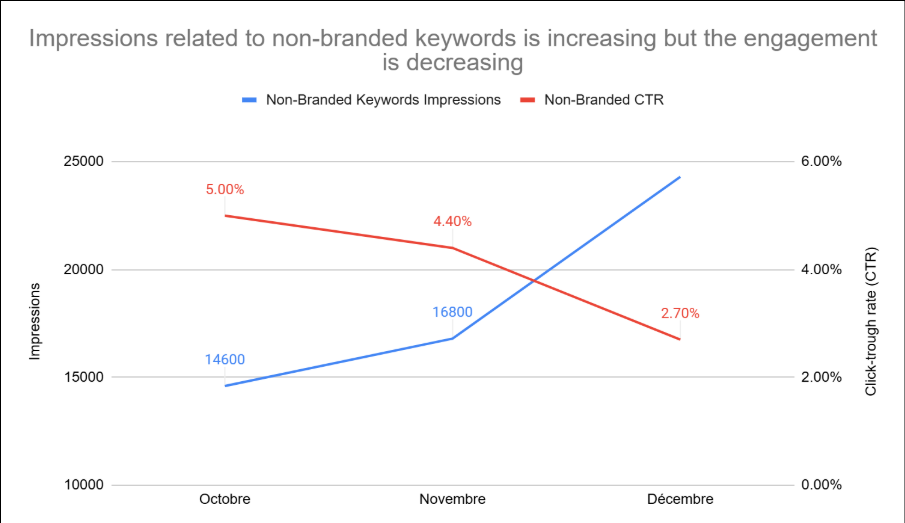
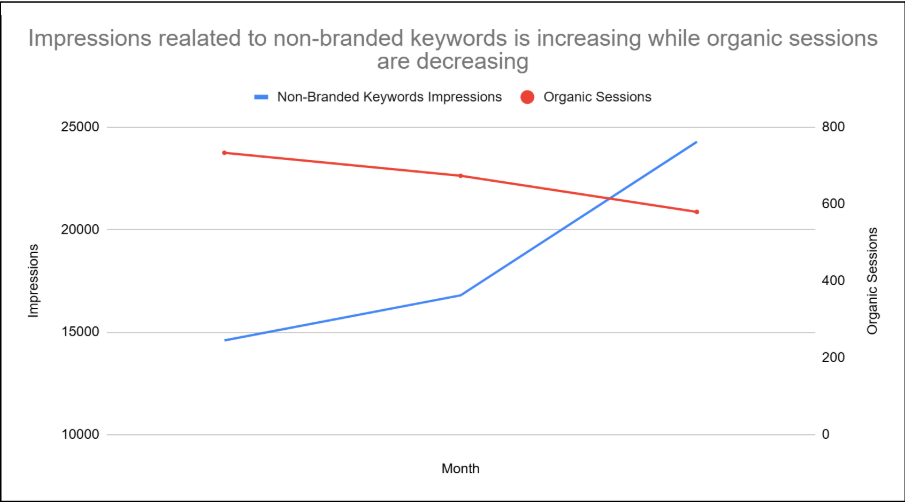
We observe this “zero-click gap” at Maïeutyk. There are several ways to observe this phenomenon. Among other ways, the following three charts illustrate the comparative data needed to observe this phenomenon.
1- Comparing impressions and click-through rates for non-branded keywords is a good initial indicator.
2- Next, a comparison—for the same period—between the number of impressions associated with non-branded keywords and the decline in the number of organic sessions confirms our hypothesis regarding the emergence of the “zero-click gap.”
3- For this same period, it is also essential to check the average ranking of this site’s pages for keywords not related to the brand name, to ensure that users can see the link to these pages. Since the average ranking is #9 on Google’s search results page (SERP), this confirms the impact of the “zero-click gap” on this site.
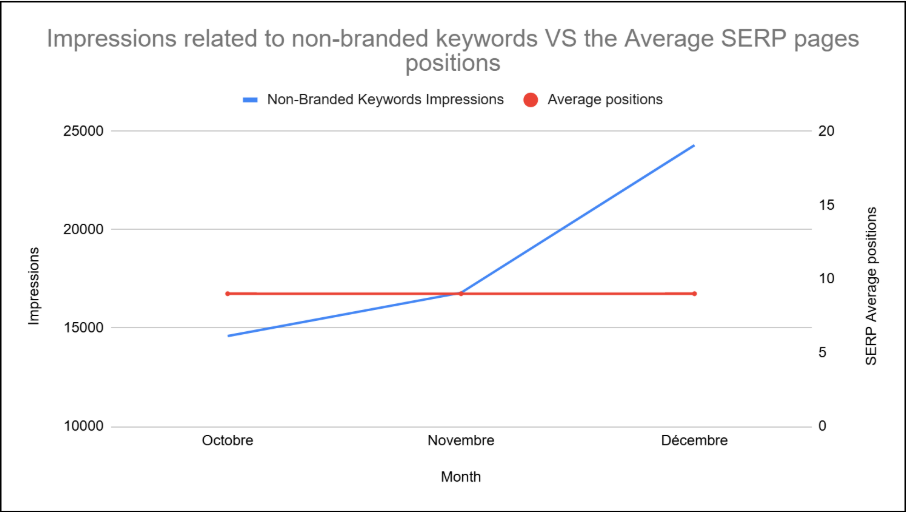
These three charts show that, for this site and the given period, content visibility (number of impressions) is increasing and the average ranking is relatively accessible to users (#9), while site visits and engagement are declining significantly (number of sessions and click-through rate). Therefore, the number of sessions is no longer our primary indicator of content creation performance.
2- The Fragmented ROIs
How AI Has Changed the Economic Equation of Distribution
The ROI of content marketing hasn’t simply declined. It has undergone a profound restructuring. Some levers that once generated exceptional returns have become virtually worthless. Others, long neglected, have become decisive multipliers.
It is no longer content that constitutes the constraint, but distribution.
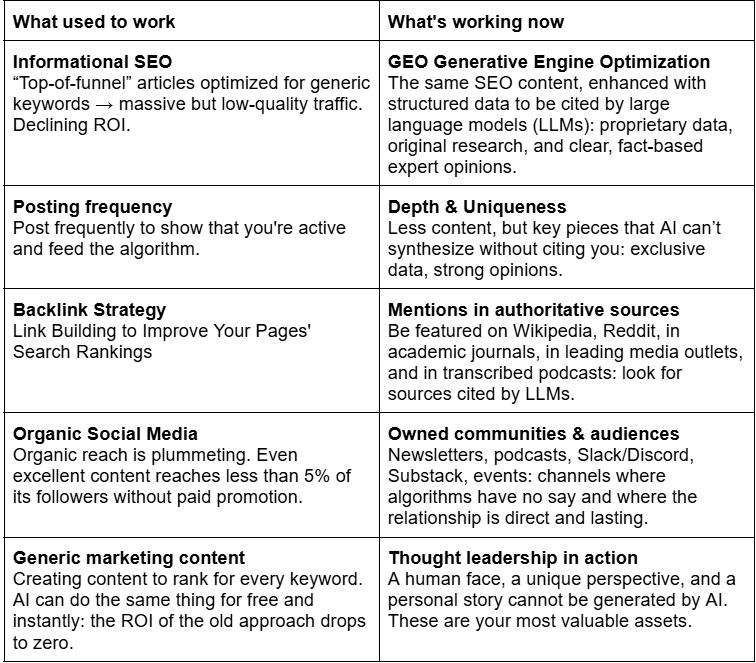
Over the past few months, we’ve noticed among our clients on LinkedIn that informational content no longer performs as well as relevant opinion-based content combined with personal stories. This trend can be attributed to LinkedIn’s new algorithm (Brew360), which penalizes AI-generated generic content. This change is perfectly in line with what’s happening on search engines.
Key Takeaway
ROI hasn’t disappeared. It has changed: generic content is now worth nothing, while unique and authentic content, such as analyses of your data, your voice, and your real-life experience, is worth more than ever.
3- The New Strategy and Its Action Plan
3.1 The Distribution Model for the LLM Era
Given this reality, a new distribution architecture is needed. It is based on four complementary and inseparable Pillars.
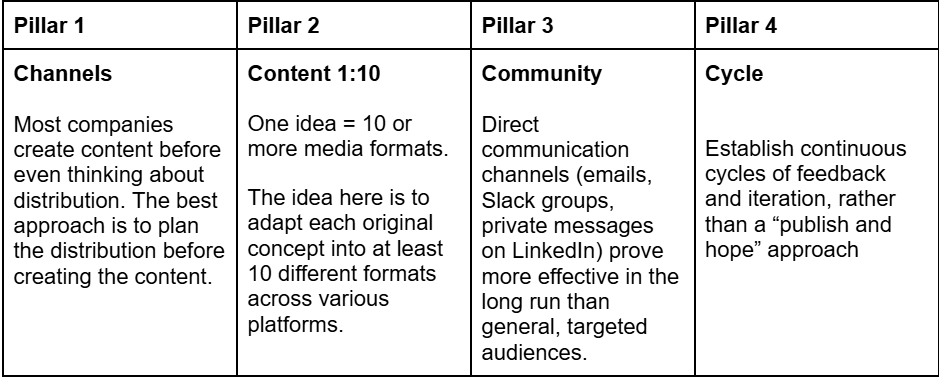
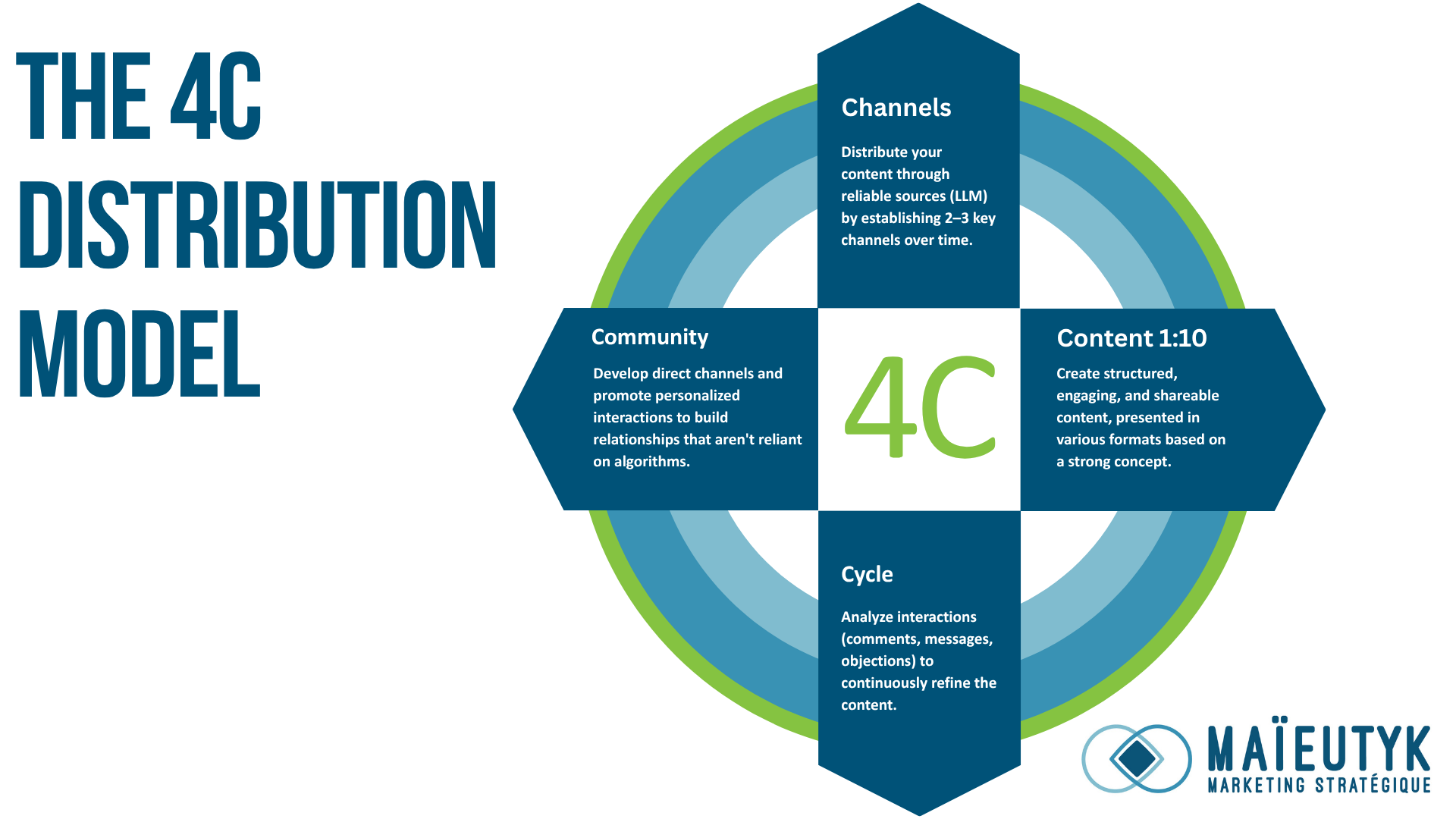
C for Channels
- Share your opinions and expertise through sources deemed reliable by LLMs.
- Identify your three main channels and post the same content on each of them for at least 90 days. Example:
- LinkedIn (authority engine)
- Email newsletter (own channel)
- 2 to 3 specialized communities (Slack, Reddit, Wikipedia, industry groups)
C for 1:10 Content
- Produce structured content that is easily extractable and citable by LLMs.
- Put human faces and strong opinions behind the brand.
- Define 3 key areas around which you will create content
- Expand on each original idea and bring it to life in at least 10 formats across different platforms: infographics, text-only content, 30-second videos, FAQs, opinions, questions, etc.
C for Community
- Build direct channels that aren’t dependent on algorithms (newsletters, direct emails from your CRM, etc.).
- Engage as much as possible in one-on-one conversations by phone, email, or on LinkedIn.
C pour Cycle
- Forget about “Likes” and the number of impressions.
- Start tracking the following metrics:
- Substantive comments that make sense and generate discussion
- Private messages
- Sales conversations that are starting
- Objections and strong opinions against your message.
- Create a simple, iterative follow-up process; each week or month, write down:
- The 10 most important comments
- The 5 biggest objections
- The 3 most relevant questions
- Organize your next content around these topics.
3.2 Steps in the Action Plan
3.2.1 Optimization for Generative Engines (GEO)
Traditional SEO optimizes for indexing bots. GEO is optimized for an LLM to understand. This means it is essential to:
- Write with a strong semantic structure
- Take clear and authentic positions
- Produce original data that the model cannot find anywhere else
- Build an opinion in a specific domain rather than a broad, superficial presence.
An LLM will cite a source when it is indispensable: when the information is unique, when the source is a leading authority in its field, and when the content has been referenced and discussed in sources the model deems reliable.
3.2.2 Citation Strategy in Training Corpora
LLMs have been trained on a “snapshot” of the web. But they continue to evolve due to context-enriched generation (RAG: Retrieval-Augmented Generation) and updates to their knowledge bases. Being present on Wikipedia, Reddit, in academic publications, in leading media outlets in your industry, and in transcripts of popular podcasts: these are the true “backlinks” of the LLM world.
This logic leads us to view public relations (PR) not as a peripheral activity, but as a key driver of algorithmic visibility.
3.2.3 The Newsletter as Brand Infrastructure
While algorithms can make you invisible from one day to the next, an email subscriber list or your contacts in your CRM cannot be taken away from you. The newsletter is not just another channel: it is your direct line to your most engaged audience, independent of any other platform or algorithm.
Among our clients, we’ve noticed that newsletters, though less frequent, achieve open rates above industry benchmarks.
It is therefore advisable to send a quarterly or biannual newsletter, with well-targeted articles relevant to your audience, rather than flooding their inboxes every month with generic content.
3.2.4 Embodied thought leadership is a defensive tool
AI can replicate a tone, mimic a style, and generate informative content. However, it cannot replace a lived experience, a stance that carries reputational weight, or a personal story that lends credibility to an argument. Founders, experts, and recognizable human voices have become a brand’s most defensible asset for outreach.
I am convinced that most SME leaders and owners are unaware of these major changes. Their marketing teams continue to create content “business as usual” without considering the negative impact it will have on their brand. A new content and distribution strategy, accompanied by iterative monitoring of new performance metrics, must be developed and implemented quickly.
3.2.5 The Community as a Driver of Organic Distribution
Platforms are losing their ability to spread organically. Communities, on the other hand, are gaining power. A private Slack channel, a private Facebook discussion group: these spaces generate word-of-mouth that neither AI nor algorithms can silence. The brand that brings people together becomes the brand that lasts.
FAQ – Frequently Asked Questions
What professionals ask us most often
What is GEO, and how is it different from SEO?
SEO (Search Engine Optimization) optimizes content for good ranking in search engine results, such as Google. GEO (Generative Engine Optimization) goes further: it structures content so that an LLM cites it directly in its generated response. Where SEO aims for clicks, GEO aims for mentions. The signals are different: GEO prioritizes unique data, formal definitions, authoritative positions, and presence in sources that models consider authoritative.
My site has been losing organic traffic since the introduction of AI-powered snippets. Is this reversible?
The structural trend is difficult to reverse using the same tools that caused it. However, it can be offset by a different strategy: diversify your acquisition channels (newsletters, communities, partnerships), produce content unique enough to be cited, including in AI responses, and build an audience that doesn’t depend on organic traffic. The question is no longer “how to recover this traffic” but “how to build a reach that can’t be taken away from me.”
How can I know if my content is cited by LLMs?
There are several complementary approaches:
- Regularly test popular LLMs (ChatGPT, Gemini, Claude, Perplexity, etc.) with queries related to your areas of expertise and note whether your brand or content appears
- Use tools designed to detect AI mentions, such as SiteChecker or SEMrush.
- Monitor your backlinks in Google Search Console to determine if sites citing your content are considered authoritative.
Where should you start to transition to a GEO strategy?
Three priority actions to take:
- Audit your existing content to identify your 3 to 5 most “evergreen” and quotable pieces (those containing unique data or an original perspective), then restructure them with formal definitions and an “LLM-ready” summary.
- Launch a newsletter if you don’t have one: it’s your channel least dependent on algorithms.
- Plan at least one study or survey in your industry over the next 6 months: exclusive data is the most powerful GEO asset a brand can produce.
Does a YouTube channel play a key role in a GEO strategy?
Absolutely! Google currently owns YouTube, and the SERP has completely changed! I invite you to try this test:
- Do a quick Google search by typing: “What is the best free CRM software?”
- You’ll notice that the SERP displays, in order: “sponsored” results from Google Ads, the AI preview, and YouTube videos. Organic results appear at the bottom of the page.
The 4C distribution model explained above includes pillar #2 for 1:10 Content. This pillar involves adapting an original idea into 10 or more media formats. Video content distributed on YouTube is part of this.
What this means for you, in practical terms
The era of LLMs does not spell the end of content marketing. It spells the end of lazy content marketing, the kind that relied on volume, mechanical consistency, and technical optimization as substitutes for strategic thinking.
The brand that will succeed in this new environment is not the one that produces the most. It will be the one with the most quotable ideas, the most unique data, the most engaged community, and the most recognizable human voices. It will be the one that understands that in a world saturated with AI-generated content, authentic humanity is the ultimate, inimitable differentiator.
* AI tools were used to assist in writing this blog post.
Share