Prioritize, decide, act: the tools to turn ideas into impact
Key points
- The right answer to the wrong question is still a bad decision: you must clarify the problem before choosing a solution.
- A SMARTER goal transforms a vague intention into an actionable and measurable target.
- Three practical tools: the effort-impact matrix, the weighted decision grid, and risk assessment structure the transition from idea to action.
- Human, financial, and material resources must be secured before launching a project, not after.
You have ideas. You see opportunities. You even have a clear vision of the direction to take. But there is often a gap between intention and action that goodwill alone cannot bridge.
In strategic planning, there are often more ideas than time to implement them, more opportunities than resources to seize them, and more options than clarity to choose between them. In this fog of possibilities, the risk is getting stuck in analysis without ever taking action, or, conversely, spreading yourself too thin by taking on too many initiatives at once.
To explore this difference between a strategic idea and its concrete implementation, check out our article “Setting Course for Success: Navigating Between Strategy and Action.” It explains why a good strategy must always be accompanied by a clear, realistic, and structured plan.
In this blog post, we share practical tools that help transform an idea into a strategic decision and a decision into measurable action.
The trap of the wrong question
“There is nothing worse than the right answer to the wrong question.”
This sentence sums up a common mistake: rushing to a solution before clarifying the real problem. A decision may seem logical, relevant, and urgent, but if it addresses a symptom rather than the actual cause, it risks creating more activity than impact.
When diagnosing issues with our clients, we often hear statements that go something like this: “Here’s my problem, because… because…” There is then an accumulation of justifications, but not always a clear articulation of what the organization is actually trying to solve.
Before choosing between Option A and Option B, a fundamental question arises: What question is your decision addressing?
Are you looking to increase sales? Improve retention? Reduce downtime? Boost visibility? Better structure your priorities? The answer to these questions will determine whether the options before you are truly the right ones to consider.
To learn more about the pitfalls that prevent plans from turning into concrete actions, you can read our article “The top five reasons why strategic plans fail.” It helps you better understand why certain initiatives, even well-intentioned ones, fail when they aren’t sufficiently clarified, monitored, or aligned.
The SMARTER goal: turning a problem into an actionable target
Once you’ve formulated the right question, the next step is to turn it into a SMARTER goal:
- Specific: What exactly do we want to accomplish?
- Measurable: How will we know we’ve succeeded?
- Achievable: Is this realistic given our current resources?
- Realistic: Is this aligned with our context and constraints?
- Time-bound: By when do we want to achieve this?
- Evaluable: How will we measure success along the way?
- Rewarded: How will we recognize when the goal has been achieved?
The last two elements—evaluated and rewarded—address two common blind spots. The first: launching a project without defining how we’ll know we’re making progress. The second: reaching a goal and immediately moving on to the next one, without taking the time to acknowledge the progress made.
In the long term, this dynamic can be exhausting for teams. A well-formulated goal is therefore not just an administrative exercise. It serves as a compass to help stay on course, measure progress, and better support implementation.
To explore this approach to marketing objectives further, you can also read our article “Setting SMART Marketing Objectives,” which outlines the basics of formulating clearer and more measurable objectives.
Tool #1: The effort-impact matrix
When multiple options are on the table, the effort-impact matrix helps you step back and prioritize actions with greater clarity. It encourages you to evaluate each option based on its potential impact on revenue, brand, positioning, effectiveness, or customer experience, while taking into account the effort required to implement it—whether in terms of time, human resources, financial investment, or implementation complexity.
This matrix allows you to classify options into four categories:
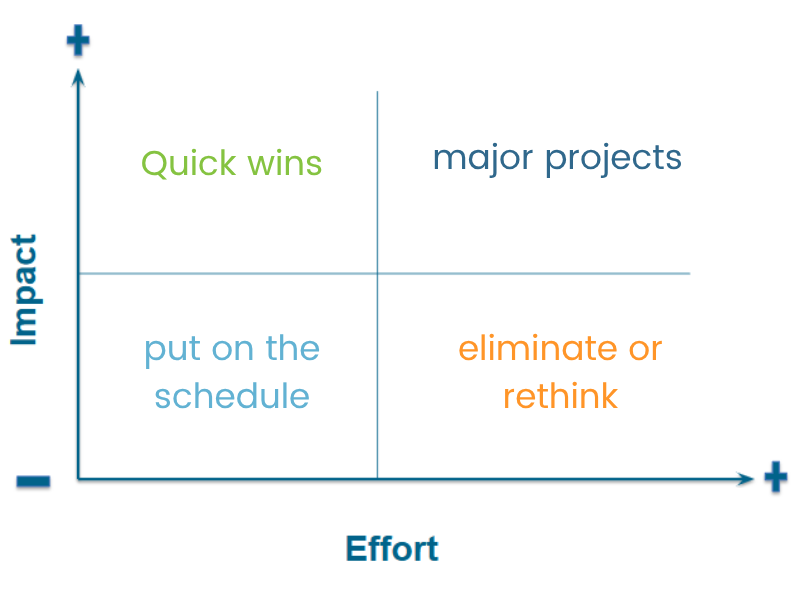
This tool is particularly useful for short-term decisions, especially those involving the next 30 days. It helps you move away from a reactive mindset and adopt a conscious approach to prioritization.
To place this tool within a broader marketing context, you can read our article “Marketing explained in 5 key concepts,” which outlines the fundamentals to consider before deciding which actions to prioritize.
Tool #2: The weighted decision matrix
For more complex decisions, particularly those involving medium- or long-term strategic directions, the weighted decision matrix allows you to evaluate options with greater perspective.
The idea is to list the possible directions, then rate them according to several criteria:
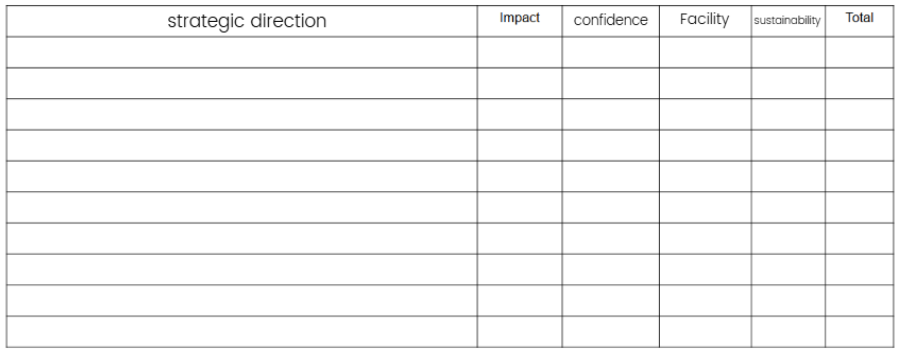
Once you’ve jotted down your options, the total score allows you to compare your choices more objectively. This tool helps you step back from your emotions, since we all have intuitions, preferences, and impressions about our ideas.
What if the option that comes to mind isn’t the one you were hoping for? That’s exactly where this exercise becomes useful. It sparks a discussion and helps you understand why your intuition doesn’t fully align with rational criteria.
This step is also important for avoiding certain common mistakes in marketing decisions. To continue this discussion, you can read our article “5 common mistakes when developing your marketing strategy,” which highlights common pitfalls when decisions are made too quickly or without a clear framework.
Tool #3: risk assessment
The third tool involves taking the time to identify what could go wrong before launching a project.
This exercise may seem uncomfortable. It requires examining potential risks, constraints, unforeseen events, vulnerabilities, and conditions that could hinder the project’s success. But this step is precisely what helps reduce uncertainty.
The highest-risk scenarios must then be accompanied by a contingency plan.
- If this risk arises, what do we do?
- Who should step in?
- What resources will be needed?
- What Plan B can we activate?
Risk management is personal. Every entrepreneur, every organization, and every team has their own comfort zone. The goal is not to eliminate risk, as that is rarely possible. Rather, the goal is to understand it, assess it, and manage it consciously.
When a decision involves too much risk, it is sometimes more strategic to slow down than to push forward at all costs. This pause often allows us to identify what needs strengthening before taking action, whether it involves strategic alignment, market validation, available resources, or the robustness of the action plan.
To learn more about mistakes related to blind spots, poor choices, or hasty decisions, you can also read our article “10 Common B2B Marketing Mistakes to Avoid.” It can help you recognize certain habits that undermine the quality of strategic decisions.
The pitfalls that derail the move to action
Even with the best tools, certain mistakes often recur when an organization tries to move from idea to impact.
Among the most common:
- Skipping the step of asking the right question: rushing toward a solution before understanding the problem.
- Confusing activity with progress: being busy without moving toward the goal.
- Lack of resources: launching a project without the human, financial, or material resources to see it through.
- Lacking follow-through discipline: having a good plan but failing to stick to it over time.
This last point is particularly important. Many strategic plans aren’t abandoned because they were bad. They’re abandoned because day-to-day operations take over, because priorities shift, or because no one regularly revisits the action plan.
Sticking to your action plan isn’t always exciting, but it’s what makes the difference between a good idea and real impact.
On this topic, our article “Setting Course for Success: Navigating Between Strategy and Action” can help you better understand how to connect strategic directions, operational priorities, and concrete actions.
The summary: from idea to impact
Here is the complete process for turning an idea into concrete action:
- Clarify the issue — What am I really trying to solve?
- Formulate a SMARTER goal — Is it specific, measurable, and set within a clear timeframe?
- Weigh effort against impact — Which options offer the best balance between impact and effort?
- Use the decision-making grid — Which approaches are most relevant based on impact, confidence, ease, and financial viability?
- Assess risks — What could go wrong, and what contingency plans should we put in place?
- Validate resources — Do we have the human, financial, and material resources to succeed?
- Take action — With discipline, follow-through, and the ability to adapt.
If a step reveals a roadblock, a misalignment with your mission, too high a risk, or insufficient resources, that’s not a reason to push ahead anyway. It’s an invitation to consolidate before moving forward.
Take action
To turn an idea into a strategic decision, you don’t have to overhaul everything right away. The first step is often to step back, reassess your priorities, clarify the real issue at hand, and ensure that your objectives, resources, and risks are clearly defined so you can move forward with confidence.
You can start by:
- Identifying the strategic decision that requires the most clarity;
- Formulating the question this decision must actually answer;
- Transforming this question into a SMARTER objective.
- Comparing your options using an effort-impact matrix or a decision-making grid;
- Assessing the risks and necessary resources before taking action.
If you’d like to better understand where your priorities lie and identify areas of misalignment that may be slowing down your decision-making, you can complete our diagnostic assessment. It will help you evaluate your level of alignment and agility to identify the most relevant actions for moving from idea to impact.
Share