Choosing Your Next Growth Engine: A Method to Evaluate Market, Offering, Positioning and Internal Capacity

Key Takeaways
- Many growth initiatives fail because companies move too quickly away from what they do well, not because the market itself was necessarily a bad one.
- A growth engine should be evaluated across four dimensions: market, offering, positioning and internal capacity.
- The total score on a grid is not enough. The weakest dimension tells you what needs to be tested or corrected before investing.
- A strong evaluation leads to a simple decision: one priority option, one option being validated, and the others put on hold.
Monday morning, management meeting. The sales director wants to expand into Ontario. The operations director proposes offering maintenance contracts to existing customers. A board member has read that automated warehouses are experiencing rapid growth. Three good ideas, an annual budget of $75,000 and a team that is already busy.
For a business leader, the problem is not a lack of options. It is knowing which one deserves limited resources. A poor choice does not only cost money: it consumes the team’s attention for months, often at the expense of a better opportunity.
This article presents a four-question method for choosing a growth strategy when you can only pursue one at a time. We then apply the method to this scenario.
What Is a Growth Engine, and Why Is It So Difficult to Choose?
A growth engine combines a market, an offering and a way of selling that can generate profitable revenue on a repeatable basis. It is neither a campaign nor a channel. It is a business decision that marketing then supports.
The challenge comes from a common reflex: companies often evaluate how attractive a market is before assessing their own ability to win in it. Research from Bain & Company illustrates the problem. In a Harvard Business Review article, Chris Zook and James Allen report that growth into an adjacent market fails three times out of four.
In a later analysis of nearly 200 companies, Chris Zook estimates the success rate of major growth initiatives at roughly 20%. One of the main findings was that companies had moved too quickly away from their core business and into areas where others were more capable. The odds were highest when companies introduced new products to their existing customers.
This research focuses primarily on large companies. The lesson is even more relevant for an SME, which has less room to absorb a false start.
If you have not yet taken inventory of your options, start with our article, «Diversifying Your Markets in Uncertain Times: Tools to Help You Choose Wisely». The BCG matrix, Ansoff matrix and 4 Ps help map what you already have and identify the possible paths forward. The method below takes the next step: it puts each option to the test before you invest.
The Method: Four Questions to Ask About Every Growth Option
Ask these questions in order. Each one filters out options that the previous question may have allowed through.
1. The Market: Is Demand Accessible, Not Just Real?
A growing market is not necessarily a market for you. The useful question is not, “How large is this market?” but rather, “What share can we realistically reach, and at what cost?”
Assess the size of the segment you can actually serve, the length of the sales cycle, access to decision-makers, and barriers to entry such as certifications or industry standards. A simple test: can you name 20 target companies and identify the role of the decision-maker at each one? If not, your ability to access that market still needs to be validated. To refine your segments, read our article on « Segmentation, Target Market, and Persona: The Three Pillars of Marketing Strategy».
2. The Offering: Does It Solve a Problem Your Customers Are Already Trying to Address?
A relevant offering solves a problem that the customer is already spending time or money to address. Measure the gap between what you sell today and what the new option requires: product adaptations, a new service, a different pricing structure or a new delivery model.
The best opportunities often emerge from existing customers. Zook and Allen also point out that your strongest customers are often an excellent starting point for identifying adjacent opportunities. Repeated requests, lost quotes and makeshift solutions customers have created themselves are all concrete signals.
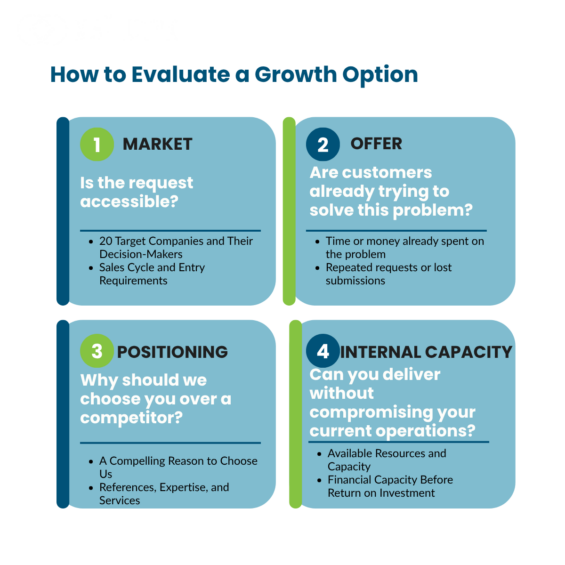
3. Positioning: Do You Have the Right to Win?
Your “right to win” is your credible reason for being chosen over the supplier the customer already knows. As Zook points out, what may be an adjacent market for you is often a competitor’s core business. And they will defend it.
List your proof points: references in that market, technical expertise, lead times, after-sales service and certifications. If your sales argument sounds the same as those of established competitors, changing the wording will not be enough. Differentiation means having a real reason to be chosen, not simply a better way of phrasing the same promise.
4. Internal Capacity: Can You Deliver Without Weakening the Core Business?
This is the question companies most often ask too late. Who will prospect? Can the plant absorb additional volume without increasing lead times for existing customers? Can the technical team support a new offering? Does the company have the financial capacity to absorb the delay before seeing a return on investment?
Chris Zook notes how surprising it is that so few management teams agree on their four or five strongest capabilities, or have even discussed them. Do the exercise with sales, operations and customer service. The answers will often differ, and that is precisely what makes the discussion useful.
Scenario: Three Options, One $75,000 Budget
Let’s return to the opening scenario. It is fictional, but representative of what many manufacturers face. The company manufactures conveyor equipment, employs about 60 people and primarily serves industrial customers in Quebec. The management team scores each option from 1 to 5 across the four dimensions.
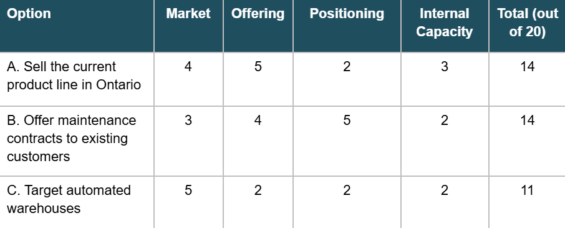
In this scenario, Option C is the most attractive on paper: it targets the most dynamic market. But it also requires an adapted offering, new positioning and resources the company does not currently have. It is put on hold.
Options A and B are tied. This is where the method becomes useful: the total score does not decide between them, but the weakest dimension does.
The weakness of Option A is positioning. No one knows the company in Ontario, and local competitors are already established. Building awareness takes time and budget.
The weakness of Option B is capacity: the technicians are already very busy. This problem could potentially be solved more quickly, for example through hiring or a partnership with a subcontractor.
In this scenario, B becomes the priority growth engine and receives approximately 70% of the budget. The remaining 30% is used to validate A on a small scale, for example through a trade show and a series of targeted meetings.
Success criteria are defined in advance and tied to revenue: signed contracts, recurring revenue and margins. Website visits or leads are only early indicators. After 90 days, the team decides whether to continue, adjust or stop.
Mistakes That Distort the Evaluation of a Growth Option
- Evaluating alone. The business leader sees the market, sales sees the objections, and operations sees the bottlenecks. A score assigned without their input is simply quantified intuition.
- Confusing market size with accessible market. A multibillion-dollar market tells you nothing about how much of it you can realistically capture next year.
- Scoring intentions instead of evidence. “We could become experts” does not deserve a 4 out of 5 in positioning.
- Discovering your limits at launch. An offering that overloads the team ultimately hurts existing customers — the ones funding your growth.
- Looking only at the total score. Two options with identical totals can hide very different risks.
How Do You Move from Evaluation to Decision?
An evaluation only has value if it leads to a clear choice. In practice, three decisions are enough.
One priority option receives most of the resources. One validation option receives a limited budget and specific milestones. The others are put on hold and documented for the next review.
The next step is to turn that choice into a plan: owners, timelines and performance indicators. This is often where strategies end up sitting on a shelf, as we explain in “The Top 5 Reasons Strategic Planning Fails”.
The Best Growth Engine Is Rarely the Most Spectacular
The natural instinct is to look for the most promising market. But there is a more useful question: where do we have the best chance of winning with what we already have, or with capabilities we can acquire quickly?
The four dimensions do not eliminate risk. They make it visible. And visible risk can be tested, corrected or ruled out.
Choosing a growth strategy also means deciding what you will not pursue this year. For an SME with limited time and resources, the ability to make that choice is often just as important as the growth opportunity itself.
Take Action
If you are weighing several options, our free online diagnostic can help identify what needs to be clarified before you make a decision. And if you are wondering how this framework could apply to your own growth opportunities, a strategic discussion with our team can be a good place to start.
Category
Share